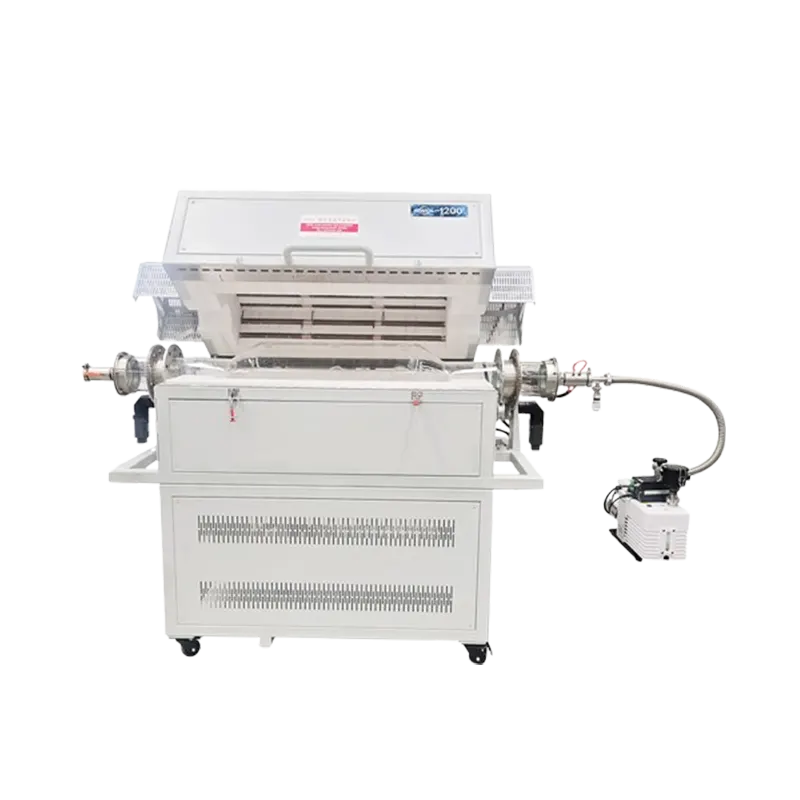
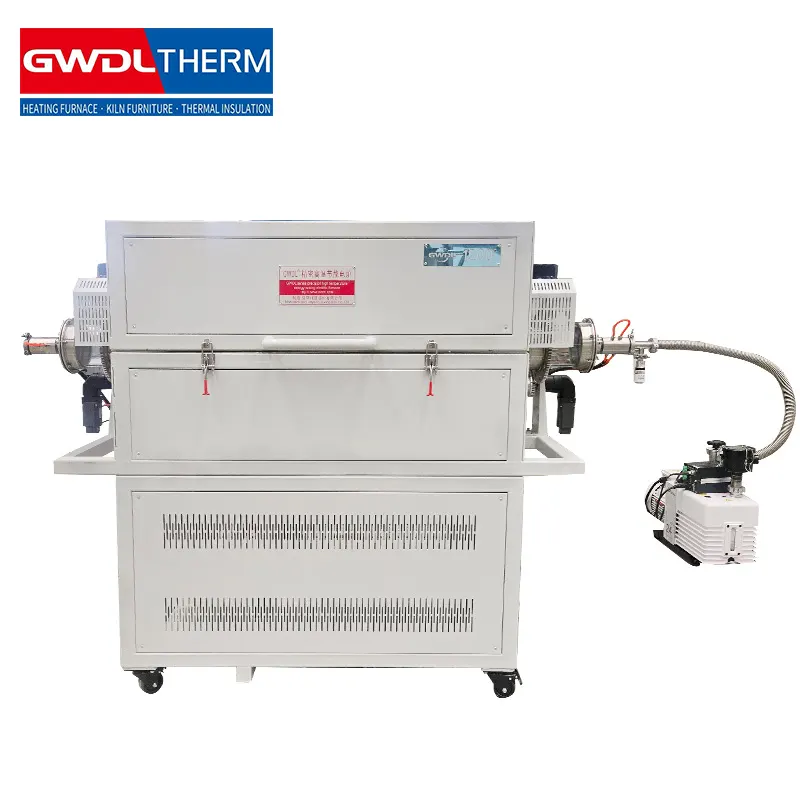
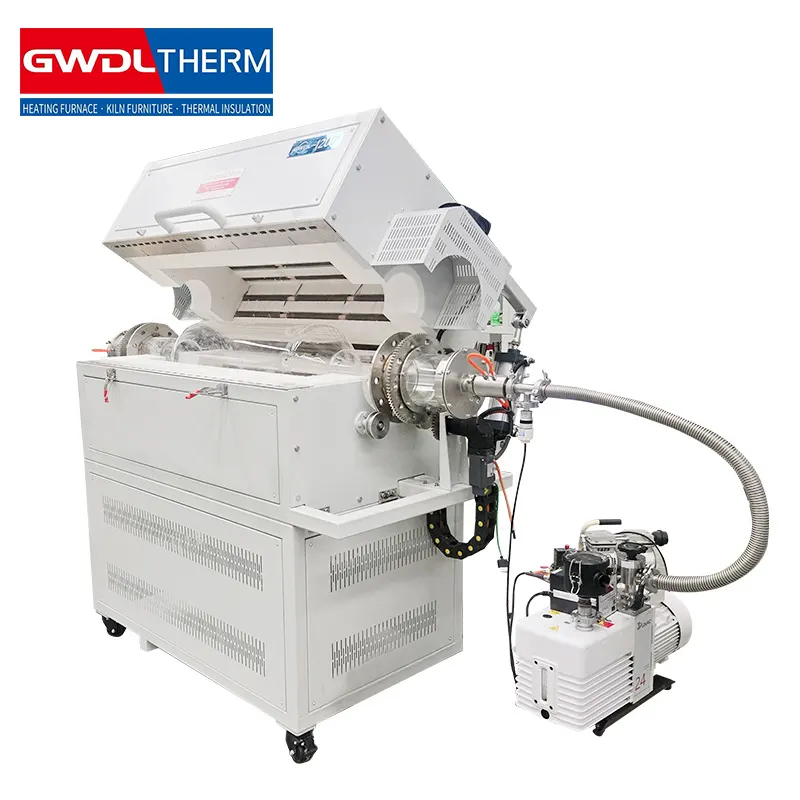
1200°C Compact Rotary Electric Furnace for Laboratory Material Processing
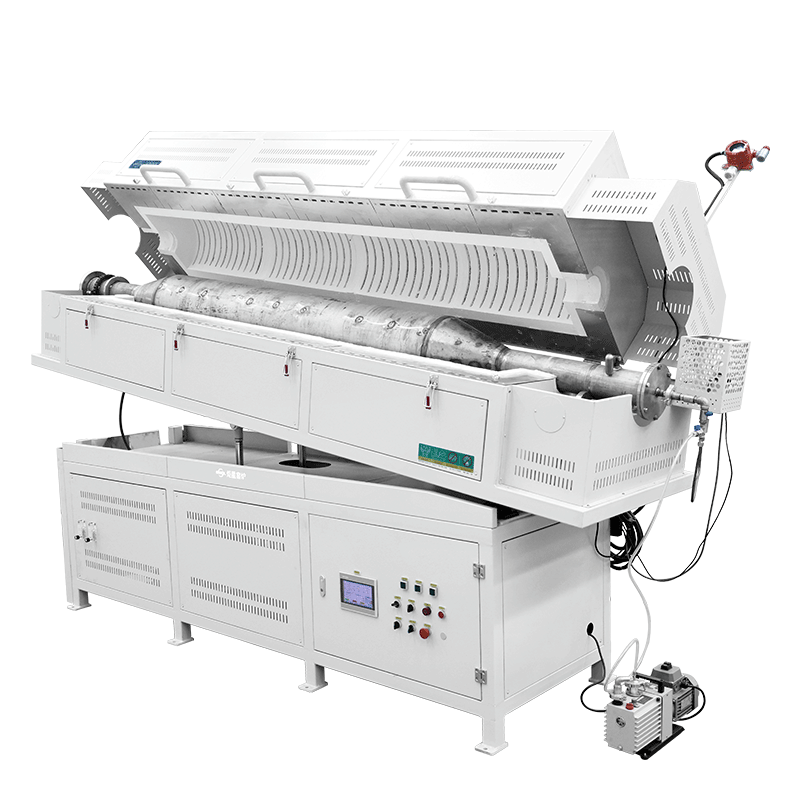
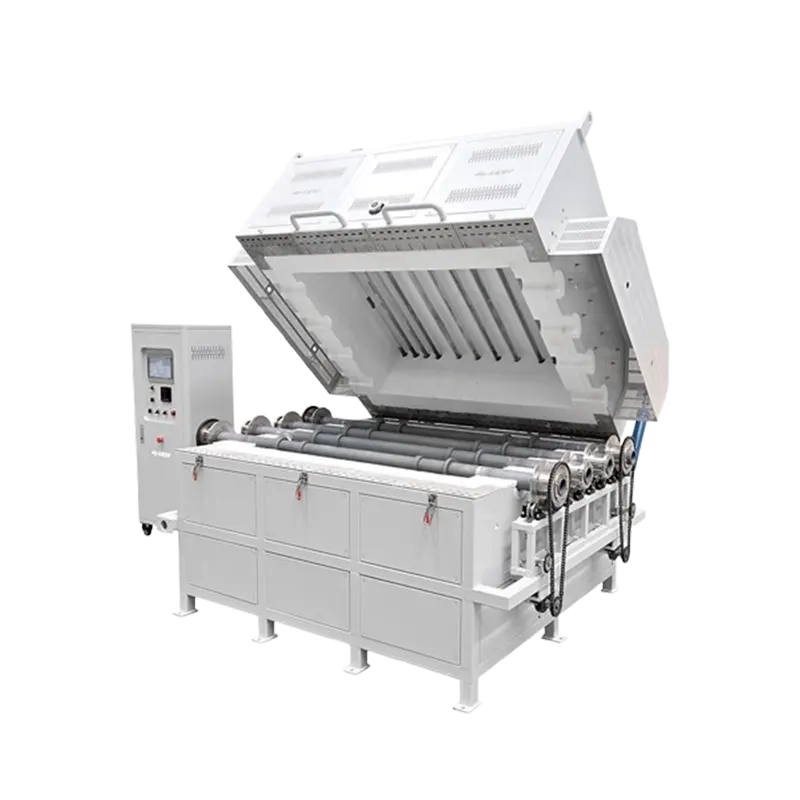
The 1200°C compact rotary furnace provides continuous material rotation and uniform heating, making it suitable for laboratory research and thermal processing.
The 1200°C compact rotary electric furnace provides uniform heating and controlled rotation for efficient laboratory material processing, sintering, and thermal experiments.
Product Features
Furnace body structure
The electric furnace body adopts a double-layer air-cooled structure designed to improve heat dissipation and enhance the reliability of high-temperature operation. The specially designed air-cooling guide baffles create an efficient airflow path within the furnace shell, allowing cool air to circulate through the double-layer structure and continuously remove accumulated heat.
During operation, the cooling airflow passes around the conductive plates of the heating elements before being discharged from the furnace body. This effectively reduces the temperature of the conductive plates and helps prevent oxidation caused by prolonged exposure to high temperatures. By protecting the conductive components, the air-cooling system helps extend their service life and maintain stable heating performance.
The double-layer structure also reduces heat accumulation around the furnace body, helping maintain a more comfortable working environment. This optimized cooling design provides effective thermal management, reliable component protection, and stable operation for laboratory material processing applications.
Refractory materials
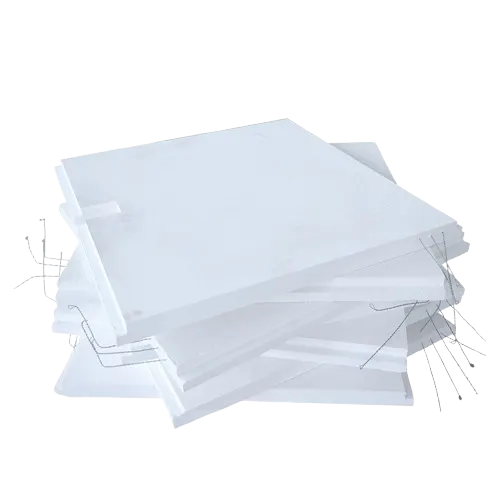
The furnace lining is constructed from vacuum-formed lightweight alumina material, providing excellent thermal insulation and reliable performance under high-temperature operating conditions. The lightweight structure reduces heat storage, allowing the furnace to heat up and cool down efficiently while improving overall energy performance.
Areas subject to frequent material handling, including the furnace opening and bottom, are reinforced with lightweight hollow alumina plates. These components provide enhanced structural stability and resistance to mechanical impact during loading and unloading operations.
The alumina lining offers excellent resistance to rapid heating and cooling, helping minimize thermal stress and reducing the risk of cracking during repeated temperature cycles. It also provides good resistance to slag shedding, helping maintain a clean furnace chamber and reduce contamination of processed materials.
With low heat storage, high-temperature resistance, and efficient insulation performance, the lining supports stable temperature control, faster thermal response, and reliable long-term operation for laboratory material processing applications.
control
The furnace uses closed-loop thyristor module control technology to provide precise and stable regulation of heating power. Phase-shift or zero-crossing triggering can be selected according to process requirements, enabling continuous adjustment of output voltage, current, or power.
The control system adopts a dual-loop architecture, with the current loop serving as the inner loop and the voltage loop as the outer loop. This configuration provides constant-current, constant-voltage, or constant-power operation while maintaining sufficient regulation capacity.
When the load suddenly increases or the current exceeds the preset limit, the system automatically limits the regulator output to the rated current range. The voltage loop simultaneously participates in regulation to maintain stable output conditions.
This coordinated control and protection mechanism helps prevent excessive current and voltage surges from reaching the heating elements. It improves power stability, protects critical components, and ensures safe, reliable, and precise furnace operation during long-term high-temperature processing.
Temperature profile setting
The furnace is equipped with an intelligent temperature control system supporting multiple regulation modes, including standard PID, AI-based APID, and MPT. These control modes provide flexible temperature management for different thermal processing requirements.
The controller features automatic tuning and self-learning functions, enabling the system to optimize control parameters and maintain stable temperature performance with minimal overshoot or undershoot. It supports 30-segment programmable temperature control, allowing users to define heating, holding, and cooling stages with adjustable ramp rates.
Programmable commands include jump, loop, run, pause, and stop, while temperature programs and control parameters can be modified during operation. The integrated AI-based regulation algorithm uses curve-fitting technology to optimize the temperature profile and achieve smooth, continuous control curves.
This intelligent control architecture improves temperature stability, process repeatability, and operating flexibility, making the furnace suitable for demanding laboratory material processing and high-temperature research applications.
gwdltherm Main Component Configuration List
Serial Number
project
name
Classification
factory
Remark
1200 degrees
1400 degrees
1600 degrees
1700 degrees
1800 degrees
1900 degrees
1
shell
Double-layer shell
●
●
●
●
●
●
Juxing Kiln
2
heating element
electric heater
High-temperature alloy resistance wire
silicon carbide rods
silicon molybdenum rod
1800 type silicon molybdenum rod
1850 type silicon molybdenum rod
1900 type silicon molybdenum rod
Juxing Kiln
3
Electrical control section
Temperature controller
858P
858P
858P
858P
858P
858P
Xiamen Yudian
4
thermocouple
K
S
B
B
B
B+ fiber
Taisho/Bright
5
Voltmeter
●
●
●
●
●
●
Chint
6
ammeter
●
●
●
●
●
●
Chint
7
SCR power regulator
●
●
●
●
●
●
Juxing Kiln
8
contactor
●
●
●
●
●
●
Chint/Delixi
9
circuit breaker
●
●
●
●
●
●
Chint/Delixi
10
Button
●
●
●
●
●
●
Chint/Delixi
11
buzzer
●
●
●
●
●
●
Chint/Delixi
12
Fast melting
●
●
●
●
●
●
Mingrong
13
transformer
○
○
●
●
●
●
Juxing Kiln
14
Refractory and heat-insulating furnace
Ceramic fiberboard/module
1260
1500
1700
1800
1850
Zirconia fiber 2100
Juxing Kiln
15
Insulating bricks at the furnace opening (inner door)
○
●
●
●
●
●
Juxing Kiln
16
Sintering plate
Quartz ceramics
Quartz ceramics
Corundum Mullite
Corundum Mullite
Corundum Mullite
Zirconia fiber 2100
Juxing Kiln
Application areas
Materials Research: Used for high-temperature melting, sintering, calcination, and thermal treatment experiments in universities, laboratories, and research institutes.
Ceramics & Glass Processing: Suitable for ceramic firing, glass material processing, refractory treatment, and thermal experiments requiring precise programmable temperature control.
Metallurgy & Advanced Materials: Applied to metal heat treatment, powder processing, material synthesis, and high-temperature research requiring stable and accurate temperature profiles.
Why Choose Us
Intelligent Temperature Control: PID, APID, and MPT modes with self-learning and 30-segment programming deliver precise, stable, and repeatable thermal processing.
Reliable Heating Performance: Closed-loop power control continuously regulates voltage, current, and power while protecting heating elements from electrical surges.
Flexible Laboratory Solution: Adjustable heating and cooling rates, programmable commands, and customizable configurations support diverse high-temperature research needs.
FAQ
Q1: What is the maximum operating temperature of the 1200°C rotary furnace? A: The furnace reaches up to 1200°C, providing stable and uniform heating for laboratory calcination, sintering, and other thermal processing applications.
Q2: What materials can be processed in this compact rotary furnace? A: It is suitable for powders, ceramics, minerals, and other heat-resistant materials requiring controlled calcination, sintering, or thermal treatment.
Q3: What is the advantage of the rotary heating design? A: Continuous material rotation improves heat exposure and mixing, helping achieve more uniform heating and consistent processing results during thermal treatment.
Q4: Is this rotary furnace suitable for small-batch laboratory processing? A: Yes, its compact design and small-batch processing capability make it ideal for laboratory research, material testing, process development, and sample preparation.
Q5: Does the furnace support precise temperature control? A: Yes, the furnace uses a temperature control system to maintain stable heating conditions and support accurate thermal processing for different laboratory applications.